
Published November 4, 2026
How to Hire a Chimney Repair Contractor in Cranford, NJ Without Getting Burned
A cracked firebox, spalling chimney crown, or damaged flue liner should never be treated as a minor cosmetic problem. Water can enter damaged masonry, freezing temperatures can worsen existing cracks, and neglected chimney defects may eventually require more extensive repairs.
If your chimney needs attention, choosing the right contractor is one of the most important decisions you will make. You need someone who can identify the underlying problem, explain the recommended repairs, and complete the work according to applicable safety and building requirements.
This guide explains what Cranford homeowners can safely check themselves, which repairs require professional attention, and how to compare chimney contractors before signing an agreement.
What Homeowners Can Reasonably Do Themselves
Homeowners can perform basic visual checks and routine observations without attempting repairs. These steps can help identify warning signs before they become more serious.
Check the visible firebox
When the fireplace is completely cool, use a flashlight to examine the visible firebox surfaces. Look for cracked firebricks, deteriorating mortar, loose material, and unusual rust staining.
If you notice damage, take photographs and arrange a professional inspection. Do not attempt to patch structural cracks or damaged firebox components without understanding the cause.
Look at the chimney from the ground
Use binoculars to examine the visible exterior masonry, chimney crown, and cap from a safe location.
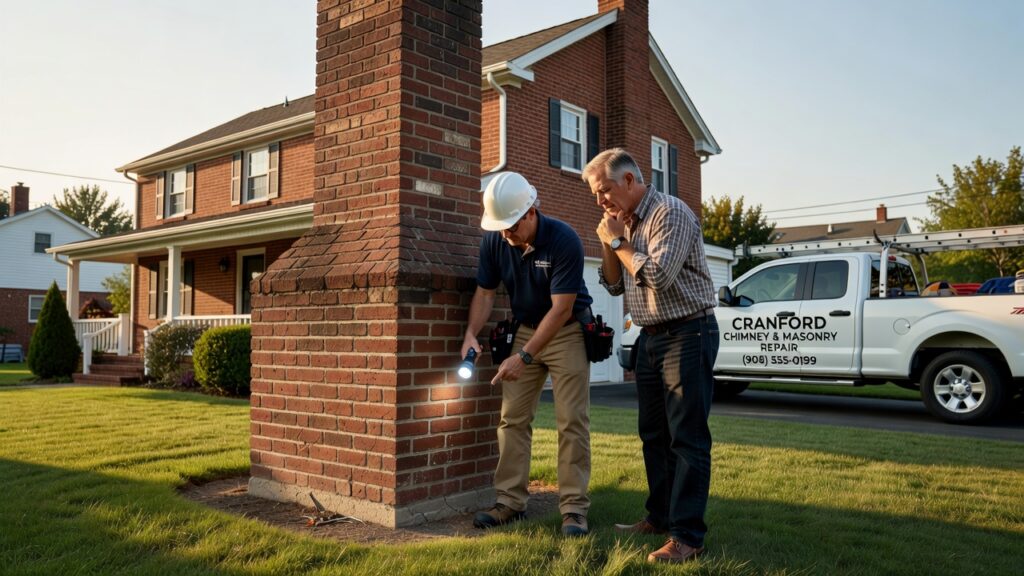
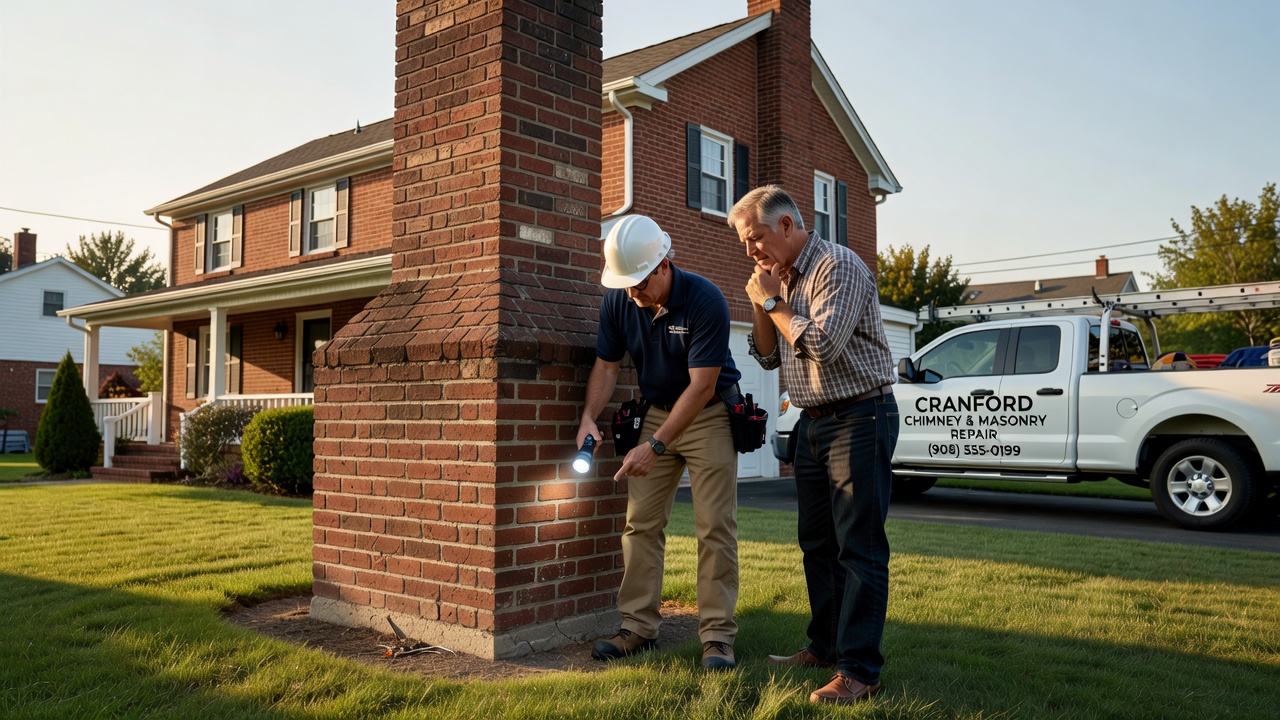
Look for missing bricks, damaged mortar joints, visible crown cracks, or a cap that appears loose or missing. Do not climb onto the roof to investigate or attempt repairs.
Watch for moisture problems
White staining on exterior brick, water marks near the fireplace, and deteriorating mortar can indicate moisture intrusion.
These signs do not identify the exact source of the water. A professional may need to examine the crown, flashing, masonry, and other components to determine what needs repair.
Monitor fireplace performance
Pay attention to unusual odors, smoke entering the room, or debris falling into the firebox.
These symptoms can indicate a blockage, damaged liner, or another problem with the chimney system. Stop using the fireplace if you suspect a safety issue until a qualified professional has assessed it.
Where should DIY maintenance stop?
Avoid climbing onto the roof, removing chimney caps, applying sealants to the crown, or attempting to clean the flue yourself. Even seemingly simple work can involve fall hazards, unsuitable materials, or hidden damage.
CSIA recommends regular professional chimney inspections because many important defects cannot be identified through basic homeowner observations.
Work That Requires a Professional
Chimney repairs involve more than applying mortar or replacing visible components. The contractor needs to understand how the masonry, liner, fireplace, and venting system work together.
The following jobs should be handled by qualified professionals.
Flue liner repair or replacement
The flue liner helps contain combustion gases and direct them safely outside the home. Cracked, separated, or deteriorating liner sections can create serious safety concerns.
Repair options depend on the liner material, the extent of the damage, and the appliance being served. Some systems may require a stainless steel liner, while others may need a different repair approach.
A contractor should evaluate the existing system before recommending replacement. A video inspection may help document the condition of the flue.
Tuckpointing deteriorated mortar joints
Tuckpointing, also called repointing, involves removing deteriorated mortar and replacing it with compatible material.
The replacement mortar must be appropriate for the existing brick and masonry. Using a mix that is too hard or otherwise unsuitable can contribute to further deterioration.
This work requires proper joint preparation, mortar selection, and application. Simply covering damaged joints with a thin layer of new mortar is not a reliable substitute for proper repointing.
Chimney crown repair or replacement
The chimney crown protects the top of the masonry structure from water intrusion.
Cracks, deteriorating material, and poor drainage can allow moisture to enter the chimney. Depending on the condition, the contractor may recommend localized repairs or complete crown replacement.
The correct solution depends on the crown’s construction and the extent of deterioration.
Structural masonry repairs
A chimney that is leaning, separating from the house, or showing significant structural cracks needs careful evaluation.
These conditions may involve foundation movement, settlement, or other structural problems. A masonry contractor may need to work with a qualified structural engineer to determine the appropriate repair.
Repairs following a chimney fire
A chimney fire can damage the liner, mortar joints, and other components even when the exterior looks relatively normal.
CSIA advises homeowners not to use a chimney after a suspected chimney fire until it has been evaluated by a qualified professional. Hidden damage may not be visible from above or below.
Certifications and Credentials to Look For
When contacting chimney repair companies serving Cranford and surrounding Union County communities, ask about their qualifications and experience.
CSIA certification
The Chimney Safety Institute of America (CSIA) offers professional certification for chimney sweeps. Certification is a useful credential when evaluating professionals who perform chimney inspections and cleaning.
Ask whether the technician who will inspect your chimney holds a current CSIA credential. You can also verify certification through the organization’s website.
Certification is not a guarantee of workmanship, and it does not automatically establish expertise in every type of masonry restoration. Ask about the contractor’s specific experience with the repair being proposed.
NFI certification
The National Fireplace Institute (NFI) offers professional credentials for hearth and fireplace specialists.
This may be relevant when the project involves fireplace appliances, installation, or related venting systems. Ask whether the credential matches the work your property requires.
New Jersey contractor registration
New Jersey requires businesses performing covered residential home improvement work to register with the Division of Consumer Affairs, unless an exemption applies.
Residential chimney repairs generally fall within the types of home improvement work covered by these requirements. Ask for the contractor’s current registration information and verify it through the state.
Questions to Ask Before You Hire
Before choosing a chimney repair contractor in Cranford, ask questions that help you understand the company’s qualifications, inspection process, and proposed work.
-
Are your technicians currently CSIA-certified? Ask which technician will perform the inspection and whether you can verify the credential.
-
Will you provide a written inspection report? Ask whether photographs and descriptions of the damage will be included.
-
Do you carry appropriate insurance? Request proof of general liability coverage and applicable workers’ compensation insurance.
-
Are you registered for residential home improvement work in New Jersey? Verify the company’s registration where required.
-
Will you check local permit requirements? Ask whether the proposed work requires approval from Cranford’s construction office.
-
How do you handle additional damage? The contractor should explain how changes to the repair scope will be documented and priced.
-
Do you use video scanning when liner damage is suspected? Ask whether a camera inspection is appropriate for your particular chimney.
-
Can you provide references or examples of similar repairs? Experience with the same type of masonry or liner problem can be valuable.
These questions help you evaluate more than the contractor’s advertised price. They also give you a better understanding of what the proposed repair actually involves.
Red Flags That Signal a Bad Operator
A contractor who identifies a serious problem should be able to explain the finding and show you supporting evidence when possible.
Be cautious of the following warning signs.
Pressure to approve expensive repairs immediately
A technician may identify damage that needs prompt attention. However, you should receive a clear explanation and a written scope of work before approving a major repair.
If the proposed work is expensive and there is no immediate emergency, consider obtaining another professional opinion.
No written estimate
Avoid agreeing to major chimney repairs based only on a verbal price.
A written estimate should identify the affected components, recommended work, materials, expected cost, and payment terms.
No proof of registration or insurance
Ask for the company’s current New Jersey home improvement contractor registration information when applicable. Request proof of insurance before work begins.
A contractor who refuses to provide basic business documentation is a reason for caution.
Vague warranties
Ask exactly what the warranty covers, how long it lasts, and whether it applies to materials, workmanship, or both.
A statement that the work is “guaranteed” is not enough without written terms.
No discussion of permits
Permit requirements depend on the nature and scope of the proposed work. Some projects may require construction permits or inspections under New Jersey’s Uniform Construction Code.
Ask the contractor to confirm the requirements with Cranford’s local construction office rather than assuming every chimney repair has the same permit requirements.
The New Jersey Department of Community Affairs provides information about the Uniform Construction Code and its requirements.
How to Compare Chimney Repair Quotes Fairly
Getting at least two written estimates can help you understand the scope and cost of the proposed work.
However, make sure you are comparing similar services. One contractor may recommend localized mortar repairs, while another may include crown replacement or additional liner work.
Check whether each estimate identifies:
-
The exact areas that need repair
-
The materials being proposed
-
The amount of masonry or liner work involved
-
Equipment and access requirements
-
Whether inspection and video scanning are included
-
Permit responsibilities, when applicable
-
Expected project duration
-
Warranty terms and payment schedule
Avoid choosing a contractor based solely on the lowest total. A cheaper estimate may exclude important work, use different materials, or provide a narrower scope.
If liner replacement is recommended, ask for the proposed liner material, size, manufacturer, and applicable product documentation. If masonry work is recommended, ask what mortar will be used and why it is appropriate for the existing structure.
A Level 2 inspection is recommended in certain circumstances, including when a property is being sold, when an appliance or fuel change affects the venting system, or after a chimney fire or other event that may have caused damage. It is not automatically required before and after every chimney repair.
The CSIA’s inspection procedure explains when a Level 2 inspection is appropriate.
Schedule Your Chimney Repair Inspection in Cranford Today
If your chimney has cracked mortar, damaged bricks, a deteriorating crown, or suspected liner damage, start with a professional inspection.
Cranford Chimney serves Cranford, Westfield, Clark, and surrounding Union County communities. Contact the company to discuss your chimney’s condition and ask about its inspection and repair services.
We offer free chimney inspections. Ask what the inspection includes and whether additional services or repairs are quoted separately.
A clear inspection report and written estimate can help you understand the problem before committing to expensive work. Choosing a qualified contractor also gives you a better chance of getting repairs that address the underlying damage rather than simply covering the visible symptoms.
Related from Cranford Chimney: How to Hire a Chimney Sweep in Cranford, NJ Without Getting Burned · Chimney Sweep in Cranford, NJ · Chimney Sweep in Cranford, NJ
Our services
Chimney Repair and Cleaning in Summit, NJ · Chimney Repair and Cleaning in Springfield, NJ · Chimney Repair and Cleaning in Scotch Plains, NJ · Chimney Repair and Cleaning in Roselle Park, NJ · Chimney Repair and Cleaning in Roselle, NJ · Chimney Repair and Cleaning in Rahway, NJ
Areas we serve
Cranford, NJ · Cranford, NJ · Cranford, NJ · Cranford, NJ · Cranford, NJ · All areas →