
Tuckpointing in Cranford and Clark, NJ: What You Can Handle and What You Shouldn’t Touch
Mortar rarely fails all at once. It usually deteriorates gradually through repeated exposure to moisture, freezing temperatures, and seasonal changes. By the time a homeowner in Clark notices a visible gap between chimney bricks, the damage may have been developing for several seasons. That does not mean every masonry problem requires immediate major reconstruction, but it does mean the condition should be evaluated before it worsens. This guide explains what homeowners can safely check themselves and where professional tuckpointing becomes the better choice.
Why Deteriorating Mortar Can Become a Bigger Problem
Brick and mortar absorb moisture. During winter, water inside masonry can freeze and expand, putting additional stress on mortar joints and surrounding brick. Repeated freeze-thaw cycles can gradually widen existing cracks and openings.
Open or deteriorated mortar joints can also allow additional moisture into the chimney structure. In systems where the chimney contains a flue or serves fuel-burning appliances, a compromised chimney system can create safety concerns that require professional evaluation.
Older homes in Cranford and Clark may have masonry chimneys that are several decades old. The original mortar may also differ significantly from modern masonry products. That is one reason simply filling a damaged joint with whatever mortar is available may not be an appropriate repair.
What a Capable Homeowner Can Safely Do
There are several useful maintenance tasks homeowners can handle themselves.
You can clean loose mortar debris and ash from the firebox after everything has cooled completely. You can also use a flashlight to inspect accessible areas around the firebox, damper, and lower masonry.
From the ground, binoculars can help you examine the exterior chimney. Look for:
- White staining or efflorescence
- Visible gaps between bricks
- Crumbling mortar
- Flaking or damaged brick faces
- Missing sections of masonry
- Obvious crown or cap damage
These observations can help you identify when professional evaluation may be appropriate.
What you should avoid is climbing onto a roof or chimney simply to investigate a problem you cannot safely reach. A ground-level observation is useful. Risking a fall to get a closer look is not.
What Genuinely Requires a Professional
Tuckpointing itself is generally professional work.
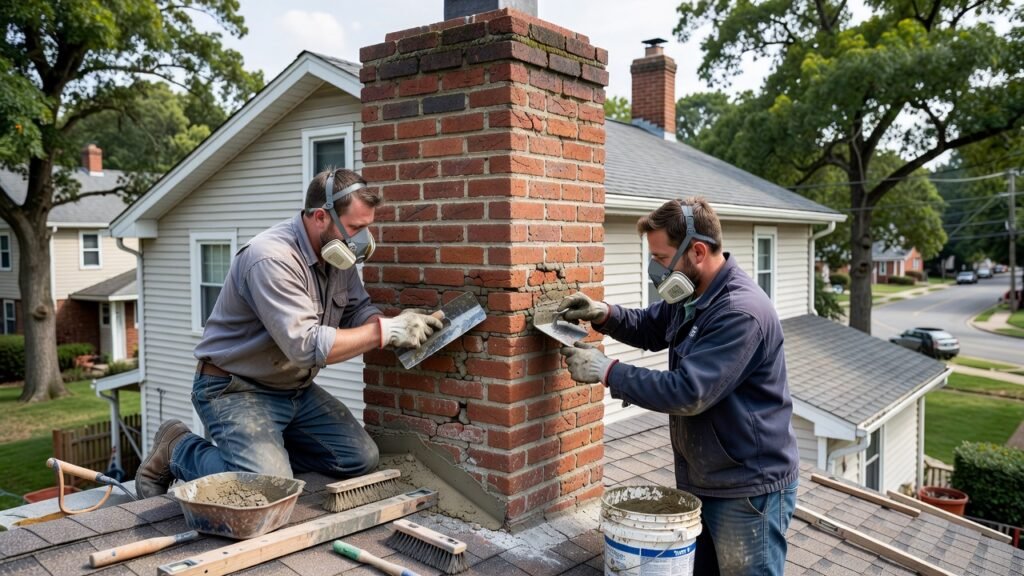
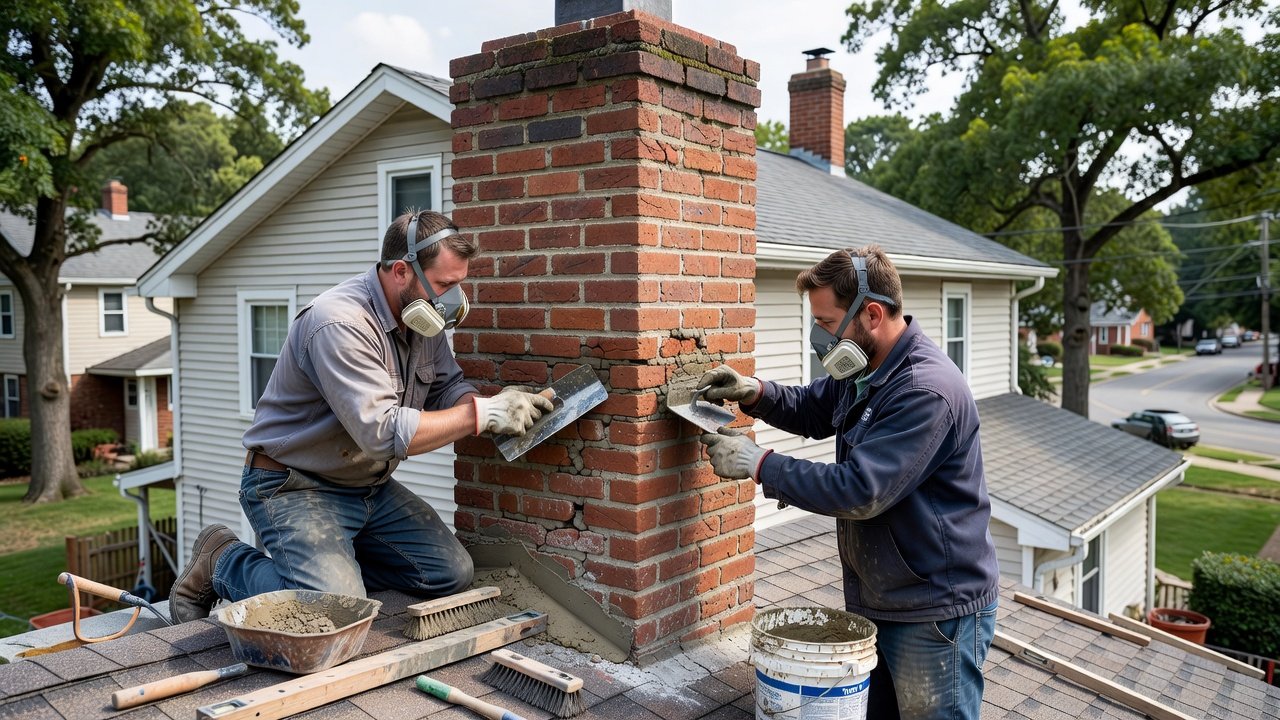
The process involves removing deteriorated mortar to an appropriate depth and installing new mortar that is compatible with the existing masonry. The replacement material needs to be selected carefully.
Using mortar that is significantly harder than the original masonry can create problems because older brick may be more vulnerable than the new mortar. A qualified masonry professional can evaluate the existing material and select an appropriate repair approach.
Working at Height
Chimney masonry repairs also involve substantial work above the roofline. A two-story home can place the chimney well above normal ladder height.
Proper fall protection, access equipment, and experience are important when removing deteriorated mortar and installing replacement material at that elevation. This is a major reason chimney tuckpointing is not comparable to repairing a small section of ground-level brickwork.
Determining the Full Scope
Visible mortar damage may not be the only issue.
Before recommending tuckpointing, a professional should look at the broader chimney system, including the crown, cap, flashing, masonry, and other accessible components. If there are signs of more extensive damage, additional inspection may be appropriate.
This helps determine whether the problem is limited to several mortar joints or whether water intrusion has affected a larger portion of the chimney.
The Risk of Letting Deteriorated Mortar Continue
Once mortar joints begin allowing significant moisture into the masonry, winter freeze-thaw cycles can accelerate deterioration. What begins as localized repointing can eventually involve damaged bricks, crown problems, or more extensive masonry reconstruction.
The source material estimates approximately $600 to $1,200 for a typical tuckpointing project in Union County, while more extensive reconstruction can reach $3,000 to $6,000 depending on the damage.
Those figures are estimates rather than fixed prices. Chimney height, access, the amount of deteriorated mortar, brick replacement, and related repairs can all change the final cost.
What an Inspection and Repair Estimate Should Include
When Cranford Chimney evaluates a chimney, the company states that it looks beyond the visibly damaged joints. The assessment includes the crown, cap, roofline flashing, and mortar across the chimney stack.
A professional evaluation should give you a clear explanation of:
- What needs attention now
- What can reasonably wait
- Whether brick replacement is necessary
- Whether additional inspection is recommended
- What the estimated repair scope includes
A written estimate before work begins also gives you something concrete to review before approving the project.
Schedule an Inspection Before the Damage Spreads
If you own a home in Cranford, Clark, Westfield, or the surrounding Union County communities and have noticed crumbling mortar, visible gaps, white staining, or damaged brick, it is worth having the chimney evaluated.
Cranford Chimney offers free inspections and written estimates. Getting the condition assessed early can help determine whether you’re looking at a relatively contained tuckpointing project or a larger masonry problem.
Related from Cranford Chimney: Chimney Sweep Services in Cranford, NJ · Chimney Repair in Cranford, NJ
Our services
Chimney Repair and Cleaning in Berkeley Heights, NJ · Chimney Rebuilding · Chimney Inspections · Chimney Cleaning · Chimney Sweep Clark · Chimney Sweep in Westfield
Areas we serve
Cranford, NJ · Cranford, NJ · Cranford, NJ · Cranford, NJ · Cranford, NJ · All areas →